Art is the process or product of deliberately arranging elements in a way to affect the senses or emotions.
Friday, May 4, 2012
Vincent van Gogh Paintings
Vincent van Gogh's Starry Night over the Rhône on canvas (28-1/2x36-1/4 inches) that is d'Orsay in Paris. See more pictures of van Gogh's paintings.
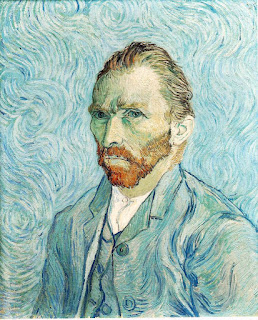
In the most limited definition of the term, Impressionism as the objective study of light did not encourage so essentially a subjective study as the self-portrait but in the later expansion of the movement this self-representation was given renewed force by Cézanne and van Gogh. The latter has often been compared with Rembrandt in the number and expressiveness of his self-portraits but while Rembrandt's were distributed through a lifetime, van Gogh produced some thirty in all in the short space of five years --- from the end of the Brabant period (1885) to the last year of his life at St Rémy and Auvers. In each there is the same extraordinary intensity of expression concentrated in the eyes but otherwise there is a considerable variety. From the Paris period onwards he used different adaptations of Impressionist and Neo-Impressionist brushwork, separate patches of colour being applied with varying thickness and direction in a way that makes each painting a fresh experience.
Almond Branches in Bloom – Painting by Vincent van Gogh
vincent-van-gogh-night-cafe
Wednesday, May 2, 2012
Claude Monet(1840—1926)
This contest is fueled by the following news:
Oscar-Claude Monet(1840—1926) is a French painter and one of the founders of the French artistic movement of impressionism. Biography: Claude Oscar Monet was born on November 14, 1840 in Paris. When he was just five years old, his family relocated to Normandy, Le Havre. His father wanted Claude to become a grocer and join the family business, but the son, since childhood, took great interest in fine arts, in particular, took with pleasure in painting caricatures. On the sea coast of Normandy, Monet met Eugene Boudin, the popular landscape painter and one of the ambassadors of impressionism. Boudin taught the young Monet some techniques in painting nature. In 1860, Monet was called up to join the army and he served in Algeria only for two years instead of the stipulated seven-year term: he was ill with typhoid and the intervention of his aunt helped the artist to demobilize. Monet took admission in university in the arts faculty but was disillusioned with the approach towards painting taught in the university. Having left the educational institution, he joined a painting workshop, which was organized by Charles Gleyre. In the workshop, he made friends with artists such as Pierre-Auguste Renoir and Frederic Bazille. They were practically contemporaries and had similar views towards art and soon formed a core group of impressionists. The portrait “Camille” or “The Woman in the Green Dress”, painted in 1866, brought fame to the painter. Later on, Camille became the wife of the artist and they had a son “Jean”. After the start of the Franco-Prussian War in 1870, Monet leaves for England, where he studies the works of John Constable and William Turner. After returning back to France at the end of 1872, Monet paints the popular landscape “Impression. Sunrise” (Impression, soleil levant). This is the painting, which gave the name to the group of impressionists and the art movement. The painting was displayed at the first impressionistic exhibition held in 1874. In 1879, Camille died of tuberculosis. In 1892, Monet remarries Alice Hoschede. Even before the marriage, Alice helped the artist by taking care of the house and bringing up the children from his first marriage. In 1883, Monet together with Alice leaves for Givenry in Upper Normandy, some 80 km northwest from Paris. Alice died in 1911. The artist endured a lot and also lost his elder son Jean, who died in 1914. In the beginning of the 1920s, Monet suffered from cataracts and had to undergo two operations. The artist died on December 5, 1926 in Giverny and was buried in a local church cemetery. The most popular paintings of Monet: * Impression. Sunrise – 1872; * Poplars, (Autumn)- 1891; * Woman with a parasol (Camille, wife of Monet, with son)- 1875; * Monet’s Garden at Vetheuil – 1880; * La Grenouillerre – 1869; * Houses of Parliament. Seagulls - 1904; * Terrasse a Sainte-Adresse (Garden at Sainte-Adresse) – 1867; * Women in the Garden - 1866—67; * Jeanne-Marquerite Lecadre in the Garden- 1867; * The Garden in Flower – 1900; * Monet Irises in Monet’s Garden – 1900; * The Marina At Argenteuil – 1875; * Boulevard des Capucines – 1873; * La Cathedral de Rouen in the sun. Harmony in blue & golden colors – 1894; * Water lilies – 1903; * Regatta At Argenteuil. Around 1872; * Boulevard des Capucines - 1873; * Saint –Lazare Station - 1877; * La Porte D Amount Etretat – 1883; * Bordighera. Italy – 1884; * Garden at Bordighera. Morning Effect – 1884; * Grain sticks at the End of the Summer , Morning Effect - 1890—91; * Houses of Parliament. London – 1905; * Water lilies – 1906; * The Japanese Bridge - 1918—24; * Breakwater at Trouville, Low Tide – 1870; * The Beach at Trouville- 1870; * The Thames at the Westminster – 1871; * Bridge over a pond of water lilies - 1899
Monday, April 30, 2012
Gourd art
Gourd art involves creating works of art using Lagenaria spp. hard-shell gourds as an art medium. Gourd surfaces may be carved, painted, sanded, burned, dyed, and polished. Typically, a harvested gourd is left to dry over a period of months before the woody surface is suitable for decorating.
Gourd decoration, including pyrography, is an ancient tradition in Africa and Asia as well as among the indigenous peoples of the Americas, notably the central highland people of Peru, the Navajo, Hopi and Pueblo nations of the American Southwest, and the Nuxálk and Haida nations of British Columbia. Gourd crafting and painting has evolved from early hand carvings to the modern day use, by some, of electric wood burners and high-speed pen-shaped rotary tools that can be used to inscribe almost any design.
Subscribe to:
Posts (Atom)


